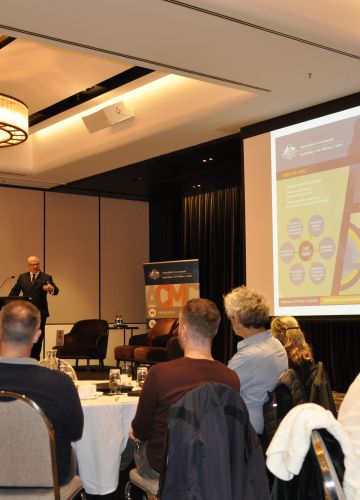
The Australian Civil Military Centre (ACMC), the Philippines Office of Civil Defense and the Armed Forces of the Philippines conducted a three-day disaster relief table top exercise in Manila on 10-12 September.
Public servants from the Australian and New Zealand governments, and civil society personnel attended the two-day Civil-Military-Police Interaction Workshop (CMPIW) in Canberra on 18 and 19 June. The aim of the CMPIW was to build capacity and knowledge among mid-career professionals by exposing delegates to a range of tools, exercises and case studies on civil-military-police coordination.
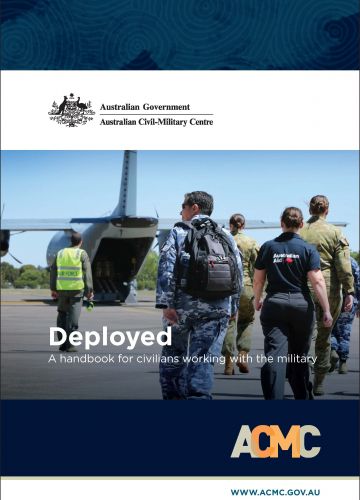
This brief publication is an introduction to the complex business of civil-military-police integration. Hopefully, you will read it prior to an exercise, not an operation. But in either case it provides good advice. Many people have gone where you are going, and this is the distillation of their experience.
This paper discusses the need for improved understanding of the challenges and opportunities faced before outlining a study that has commenced to understand and improve interaction between NGOs and militaries.
The role that new media and communications technologies have played in the recent ‘Arab Spring’ uprisings, as well as in recent disaster responses, has sparked a large amount of academic and professional interest.
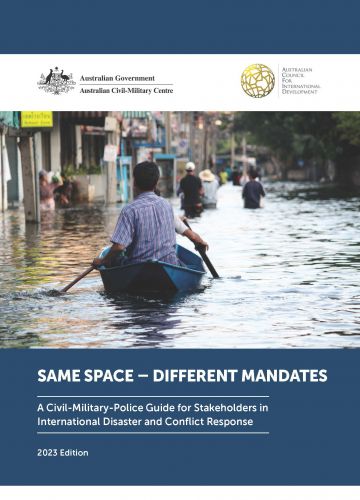
Same Space – Different Mandates aims to improve the collective understanding of civil, military and police stakeholders responding to international disasters and complex emergencies. This revised 2023 edition incorporates emerging concepts and practice to ensure accuracy and future value.
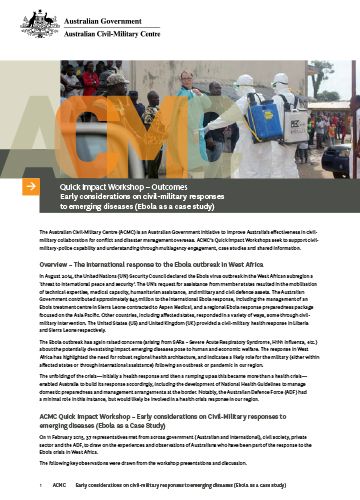
In August 2014, the United Nations (UN) Security Council declared the Ebola virus outbreak in the West African subregion a ‘threat to international peace and security’. The UN’s request for assistance from member states resulted in the mobilisation of technical expertise, medical capacity, humanitarian assistance, and military and civil defence assets.
Responders to natural disasters face increasingly complex operating environments, characterised by new challenges and new actors. Global trends that are overwhelming the international humanitarian system come into sharp focus in South-East Asia.
The three-day regional resilience workshop in Dili, Timor-Leste was an opportunity to share insights from previous responses, explore ways to further strengthen cooperation and consider developments, including an AI-enhanced early warning system.