
What does the future of civil-military-police response effort look like?
Published
Wikis and Knowledge Management in Complex Emergencies
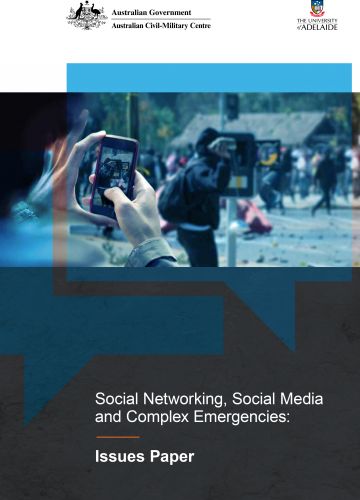
The Communication and Complex Emergencies Project is a multi-phase collaboration between the University of Adelaide’s Applied Communication Collaborative Research Unit and the Australian Civil-Military Centre.
This video discusses safety, security and self-sustainment of international responders and the importance of establishing links with the local population.
Archie Law, Executive Director of Action Aid Australia, Leanne Smith, Chief of Policy and Best Practices for Peacekeeping Operations at the United Nations and Dr Phoebe Wynn-Pope, Director of International Humanitarian Law and Movement Relations at the Australian Red Cross discuss women, peace and security in crises.
Published
Organising for Peace Operations: Lessons Learned from Bougainville East Timor and the Solomon Islands
Identifying the organisational structures that were developed for each of three operations in Bougainville, East Timor, and the Solomon Islands.
Published
Partnering for Peace
Australia’s peacekeeping and peace-building experiences in the Autonomous Region of Bougainville in Papua New Guinea, and in Solomon Islands and Timor-Leste.
Published
Skills for Multiagency Responses to International Crises
Australian responses to international, complex emergencies and humanitarian crises, generated by natural disaster, conflicts or incidents, demand the coordinated responses of multiple civil-military-police actors and agencies.
Article date
Public servants from the Australian and New Zealand governments, and civil society personnel attended the two-day Civil-Military-Police Interaction Workshop (CMPIW) in Canberra on 18 and 19 June. The aim of the CMPIW was to build capacity and knowledge among mid-career professionals by exposing delegates to a range of tools, exercises and case studies on civil-military-police coordination.
To what extent is a certain operation military versus political, diplomatic, or economic?
How does each organisation fit into the broader picture to meet the needs of the communities being served?