DFAT

Civil-Military-Police Coordination in Disaster Management: Perspectives from South East Asian countries Research paper and Stakeholder Guide

Civil-Military-Police Coordination in Disaster Management: Perspectives from South East Asian countries Research paper and Stakeholder Guide

Responders to natural disasters face increasingly complex operating environments, characterised by new challenges and new actors. Global trends that are overwhelming the international humanitarian system come into sharp focus in South-East Asia.
Women Peace & Security

Women Peace & Security

Archie Law, Executive Director of Action Aid Australia, Leanne Smith, Chief of Policy and Best Practices for Peacekeeping Operations at the United Nations and Dr Phoebe Wynn-Pope, Director of International Humanitarian Law and Movement Relations at the Australian Red Cross discuss women, peace and security in crises.
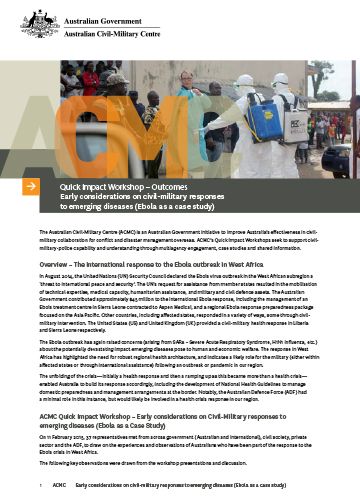
Quick Impact Workshop – Outcomes Early considerations on civil-military responses to emerging diseases - Ebola as a case study

Quick Impact Workshop – Outcomes Early considerations on civil-military responses to emerging diseases - Ebola as a case study

In August 2014, the United Nations (UN) Security Council declared the Ebola virus outbreak in the West African subregion a ‘threat to international peace and security’. The UN’s request for assistance from member states resulted in the mobilisation of technical expertise, medical capacity, humanitarian assistance, and military and civil defence assets.
Australian National Action Plan on Women, Peace and Security 2012-2018

Australian National Action Plan on Women, Peace and Security 2012-2018

The National Action Plan sets out what Australia will do, at home and overseas, to integrate a gender perspective into its peace and security efforts, protect women and girls’ human rights, and promote their participation in conflict prevention, management and resolution. ACMC has a role in the design and implementation of this plan.