Civilian agency participation in military exercises has increased over the last ten years. This is a welcome development as exercises provide a platform to strengthen Australian whole of government crisis prevention, preparedness and response capability.
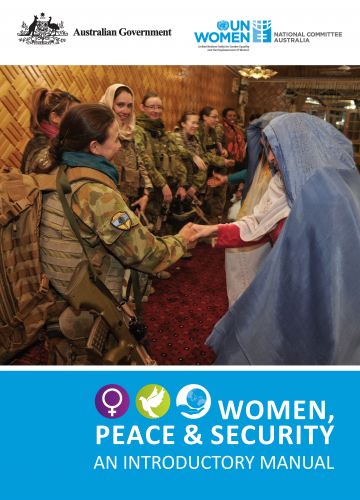
The United Nations’ Women, Peace and Security (WPS) agenda has emerged over the past decade and a half as a significant cross-cutting thematic program for achieving global peace and security.
This document affirms the principles that guide the Australian Government and its stakeholders in international multiagency response efforts. It captures the best of the learning that has come from the Australian experience of contemporary operations overseas.
Women’s leadership and collective action have changed the world by combatting violence against women and building equality. Women’s leadership is central to reconciliation and conflict resolution and to peacebuilding efforts that bring results for families and communities.
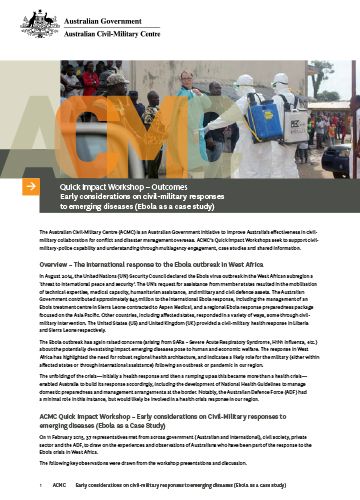
In August 2014, the United Nations (UN) Security Council declared the Ebola virus outbreak in the West African subregion a ‘threat to international peace and security’. The UN’s request for assistance from member states resulted in the mobilisation of technical expertise, medical capacity, humanitarian assistance, and military and civil defence assets.
Australian responses to international, complex emergencies and humanitarian crises, generated by natural disaster, conflicts or incidents, demand the coordinated responses of multiple civil-military-police actors and agencies.