


Humanitarian action involves immediate emergency actions that address significant needs for protection, health, water, hygiene and sanitation that emerge as a result of either a conflict or disaster.
Published
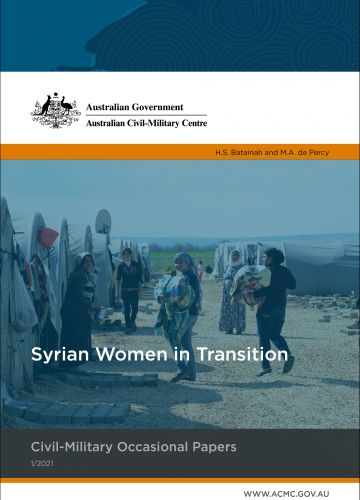
Syrian Women in Transition Civil-Military Occasional Papers 1/2021
This paper presents a snapshot of what it is like to be a Syrian woman in transition in Jordan or Lebanon. In 2019 we investigated the lives of these women to find out what challenges they face and the conditions, policies and structures that help or hinder their opportunities.
Published
Organising for Peace Operations: Lessons Learned from Bougainville East Timor and the Solomon Islands
Identifying the organisational structures that were developed for each of three operations in Bougainville, East Timor, and the Solomon Islands.

Civil Society Engagement Adviser
Tim Anderson
The ACFID seconded Civil Society Engagement Adviser to the Australian Civil-Military Centre contributes to the advancement of national capabilities to prevent, prepare for and respond more effectively to humanitarian crises through advancements in civil-military-police engagement. Building upon the partnership approach to civil-military-police engagement, the Civil Society Engagement Advisor convenes, facilitates dialogue, and provides policy advice to the stakeholder networks of both ACFID and the ACMC to strengthen understanding of the role, mandate and guiding principles of NGO engagement in humanitarian action.
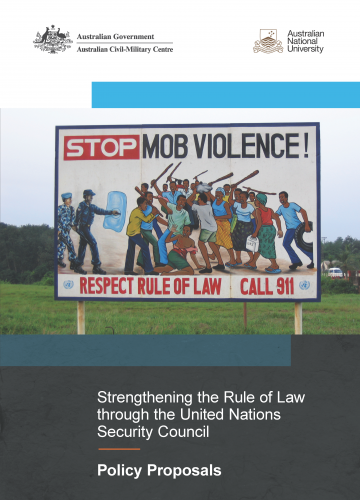
Strengthening the Rule of Law through the United Nations Security Council: Policy Proposals
These Policy Proposals are the product of a three-year Australian Research Council-funded project on ‘Strengthening the Rule of Law through the UN Security Council’.
Published
Civil-Military-Police Language Guide: Promoting shared understanding
The civil-military-police community is as diverse as it is broad. It contains a wide range of actors who employ a variety of methodologies and techniques, use unique equipment and often pursue different objectives in service of different masters.
Published
Civil-Military-Police Coordination in Disaster Management: Perspectives from South East Asian countries Research paper and Stakeholder Guide
Responders to natural disasters face increasingly complex operating environments, characterised by new challenges and new actors. Global trends that are overwhelming the international humanitarian system come into sharp focus in South-East Asia.
Published
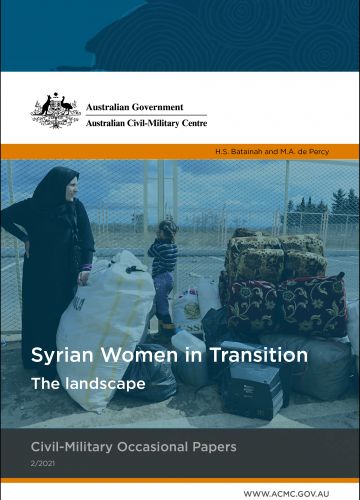
Syrian Women in Transition The Landscape - Civil-Military Occasional Papers 2/2021
Between November 2018 and November 2019, we conducted semi-structured interviews in Jordan and Lebanon, primarily in Arabic, with 100 women between the ages of 18 and 63 (most in their 30s and 40s). Our previous paper provides a snapshot of their personal experiences, showing the multi-faceted reality and diverse situations Syrian women face.
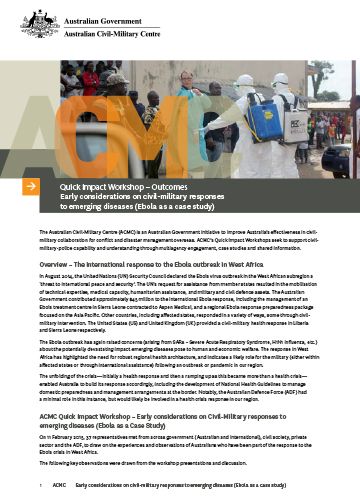
Quick Impact Workshop – Outcomes Early considerations on civil-military responses to emerging diseases (Ebola as a case study)
In August 2014, the United Nations (UN) Security Council declared the Ebola virus outbreak in the West African subregion a ‘threat to international peace and security’. The UN’s request for assistance from member states resulted in the mobilisation of technical expertise, medical capacity, humanitarian assistance, and military and civil defence assets.
Published
Australian Government Guiding Principles for Civil-Military-Police Interaction in International Disaster and Conflict Management
This document affirms the principles that guide the Australian Government and its stakeholders in international multiagency response efforts. It captures the best of the learning that has come from the Australian experience of contemporary operations overseas.